

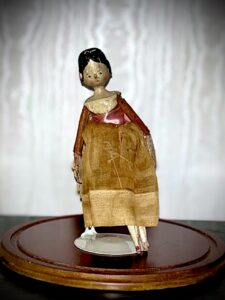
Object number 2006.171.1a
The historic homes of Peabody contain the memories of bygone eras, and in the Osborne house, the curator is making her rounds. The floor creaks and cracks underfoot as she steps past the paintings whose eyes that seem to linger. The light is shut out by heavy drapes, leaving a dreary silence punctuated by the wailing of the winds outside as a branch beats on the shutters.
On the shelf, her eyes meet the tranquil face of a doll peering out from beneath a glass case, looking unsettlingly almost human. As the curator moves on, the weight of the doll’s gaze stays with her. Dolls are the subject of many horror films and books because they mimic life but leave us uncomfortable because they are not human, as they are made to appear.
The imagination can run wild with stories, but there is nothing sinister about this piece of our collection.
She is a peg doll with a wooden body from Germany circa 1830-1840.
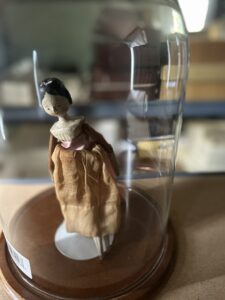
Object number 2006.171.1a with glass case
She leans lightly to the left and is dressed in a pink dress with a near-transparent, aged skirt that hides her hip pegs and legs. She has black hair that is painted on and a small neutral expression painted on her face. The doll sadly has one leg broken, but the missing peg is hidden by the dress. She is carefully and securely propped up in a glass case.
The doll likely came from either the cities of Sonnenberg or Nuremberg. Both cities had a strong toy and doll-making background in the 1830s.

Sonnenberg, Germany
While Germany is known for its porcelain dolls, there is a long tradition of wooden doll making, with even international manufacturers such as Insam & Prinoth, who are known for their woodwork, comeing ot the area. The style of the Peg Wooden Doll is also known as a Dutch Doll, Penny Wooden Doll, or Peg Wood. The pegs, from which the doll gets its name, are inserted at the shoulders and legs, allowing for the use of the joints. The first versions of this type of doll had a ball-and-socket joint type, but that level of quality takes more time and effort to produce, unlike the mass-market Peg Doll version.
It came to the collection from Ruth O’Keefe, a member of the Peabody Historical Society for forty-one years. She found it in the Felton Junior Home in the 1970s, already in the glass case that still protects it today. It has been on display on and off in the PHS since then.
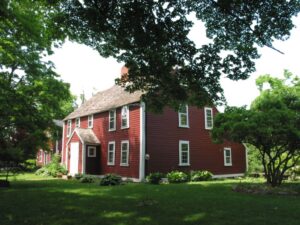
Felton Jr house
However, the rest of the story remains a mystery.

Sources:
Cësa Bugon | Geoportal. (n.d.). https://geo.museumgherdeina.it/en/obj/ar0006
Kinnison, R. (n.d.). Lady’s Repository Museum & Diamond K Folk Art. https://ladysrepositorymuseum.blogspot.com/2009/12/early-woodens.html
McRobbie, L. R. (2023, September 29). The history of Creepy Dolls. Smithsonian Magazine. https://www.smithsonianmag.com/history/history-creepy-dolls-180955916/
Reference, D. (2026, May 24). Wood, wooden antique to vintage doll brands identified. Doll Reference. https://www.dollreference.com/antique-wood-dolls/
Simpson, P. A. (2020). The play world : toys, texts, and the transatlantic German childhood. The Pennsylvania State University Press. https://doi.org/10.1515/9780271087429
The Makers: Seven German Porcelain Factories that Produced China Dolls, and Identifying Their Dolls. (2020, September 15). Quintessential Antique Dolls. https://quintessentialantiquedolls.wordpress.com/the-makers-seven-german-porcelain-factories-that-produced-china-dolls-and-identifying-their-dolls/
Toy manufacture as a cottage industry in old Gröden. (n.d.). https://web.archive.org/web/20160304031821/http://www.lusenberg.com/chiena/toymanufacture.html